[작성자:] admin
So called “FACT Act of 2013” will burden Asbestos Victims, Delay Litigation
So called “FACT Act of 2013” will burden Asbestos Victims, Delay Litigation
New Asbestos Bill Will Re-victimize Asbestos Victims

Image:TakeJusticeBack.com
H.R. 982, the so-called “Furthering Asbestos Claim Transparency (FACT) Act of 2013,” was passed
earlier last wast week. Essentially, this “transparency” will threaten the privacy of asbestos
victims. “What this bill does is allow asbestos victims to be re-victimized by exposing their
health information to the public,” Rep. John Conyers (D-Michigan) said during hearings Tuesday.
The result will be to slow down asbestos cases even more, by allowing asbestos defendants to bury the
trusts with information requests, regardless of the irrelevance or lack of need of such requests.
Commerce to let the asbestos industry off the hook. This strategy takes a
three-pronged approach:
- State
legislation: In 2007, ALEC adopted the “Asbestos Claims Transparency Act.” Louisiana,
Pennsylvania, Ohio, Oklahoma, Texas, West Virginia, and Wisconsin have seen versions of this
legislation. - Judicial Conference: On November 22, 2010, the U.S. Chamber made a direct appeal to the Judicial
Conference to change the rules governing bankruptcy law. - Federal legislation: In the 112th Congress, H.R. 4369 was introduced in the House on April 17, 2012 and
S.3076 was introduced in the Senate on May 10, 2012. In the 113th Congress,
H.R. 982 was reintroduced on March 6, 2013.
This blog post was originally published on nw-injurylawyers.com.
Why Should Anyone Seek Justice as an Asbestos Victim?
Why Should Anyone Seek Justice as an Asbestos Victim?
The Wall Street Journal recently featured a fascinating story about an asbestos victim. Bill McQueen, unlike other mesothelioma patients that we often hear about, was not a shipbuilder or construction worker. He was an Air 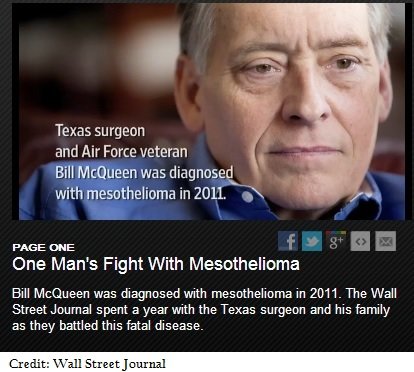 Force surgeon. Dr. McQueen had sought medical care, when his chest pain persisted. He had thought it was perhaps a flareup of an old rib fracture. However, is doctor ultimately told him that he was suffering from mesothelioma, an incurable and fatal cancer that was encasing his left lung.
Dr. McQueen represents a different type of plaintiff in the asbestos litigation. Rather than targeting one or two defendants, asbestos claims are now involving dozens of corporate defendants. Research based on asbestos filing in Philadelphia reveals that almost 50% of the mesothelioma claims from 2006 through 2010 related plaintiffs’ exposure due to do-it-yourself type of construction or auto mechanic projects. In contrast, those type of plaintiffs were only about 3% of similar claims in the prior decade (1991- 2001).
The mesothelioma was so far advanced for Dr. McQueen, when his wife began to search for an asbestos-injury attorney. In 2011, waking up from a coma, Dr. McQueen found an attorney at his bedside. The process of understanding how Dr. McQueen was exposed to asbestos began with digging through photos of an old family farm. Some of those photos showed rusty paint cans, cement bags, and insulation, all of which Dr. McQueen had worked with decades before. As a result, Dr. McQueen and his wife named over two dozen corporate defendants.
What is also interesting to see from this WSJ article is the comments. Some found the McQueens’ search for justice “disgusting,” while others viewed the claim as a sort of fishing expedition. A scant few seemed to recognize that this was the family’s attempt to hold negligent companies accountable.
Dr. McQueen passed away in his home this past March. Trial is set for this November, while several defendants have settled with the family already.
EPA Slaps a Fine on DOE Contractor
EPA Slaps a Fine on DOE Contractor
The Department of Energy, which oversees the Hanford Nuclear cleanup in Eastern Washington, got slapped with a $115,000 fine for violations in its asbestos disposal. The U.S. Environmental Protection Agency (EPA) announced earlier this week that its inspectors at the Hanford Nuclear Reservation found improperly managed asbestos in 19 of 22 samples taken at demolition sites.
Based on samples taken at six demolition areas, the EPA said waste containing asbestos was improperly disposed at a Hanford waste facility and there may be as many as 35 more sites where asbestos has, or is suspected to have been, released to the soil.
According to an NPR report by Anna King
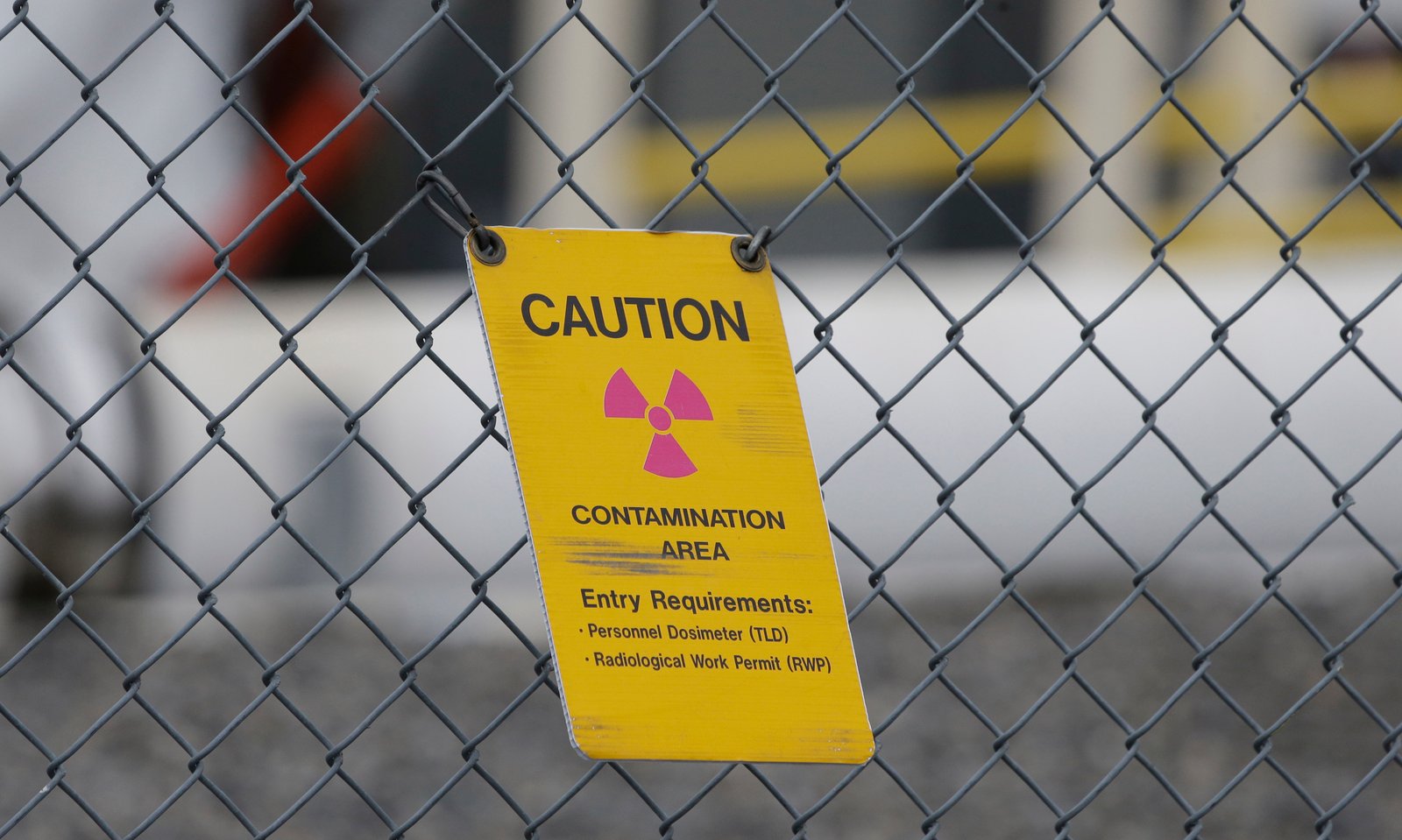
EPA fines DOE for improper asbestos removal.
the alleged violations occurred during building demolitions in 2009 and 2010 when federal stimulus money sped up deconstruction projects.
Dennis Faulk, a manager with the EPA, says the federal contractor failed to document and label truck shipments of asbestos debris.
The Hanford cleanup which includes the demolition of hundreds of buildings at the site, which processed materials for construction of nuclear weapons for World War II and the Cold War.
Uncategorized
Uncategorized
So called “FACT Act of 2013” will burden Asbestos Victims, Delay Litigation
New Asbestos Bill Will Re-victimize Asbestos Victims
Image:TakeJusticeBack.com
H.R. 982, the so-called “Furthering Asbestos Claim Transparency (FACT) Act of 2013,” was passed earlier last wast week. Essentially, this “transparency” will threaten the privacy of asbestos victims. “What this bill does is allow asbestos victims to be re-victimized by exposing their health information to the public,” Rep. John Conyers (D-Michigan) said during hearings Tuesday.
The result will be to slow down asbestos cases even more, by allowing asbestos defendants to bury the trusts with information requests, regardless of the irrelevance or lack of need of such requests.
- State legislation: In 2007, ALEC adopted the “Asbestos Claims Transparency Act.” Louisiana, Pennsylvania, Ohio, Oklahoma, Texas, West Virginia, and Wisconsin have seen versions of this legislation.
- Judicial Conference: On November 22, 2010, the U.S. Chamber made a direct appeal to the Judicial Conference to change the rules governing bankruptcy law.
- Federal legislation: In the 112th Congress, H.R. 4369 was introduced in the House on April 17, 2012 and S.3076 was introduced in the Senate on May 10, 2012. In the 113th Congress, H.R. 982 was reintroduced on March 6, 2013.
This blog post was originally published on nw-injurylawyers.com.
School Under Criminal Investigation for Using Children at Absestos Laden Site
Can you imagine using 13 year old students to help clean up debris at an asbestos contaminated building? That’s what a school in Ohio did, accordingy to a Huffington Post article. A neighbor who lived in a residence by the old YMCA building filmed the volunteers working amidst a cloud of dust.
The site, where volunteers that included young children, used to house a YMCA. As in Washington State, Ohio state law requires removal of asbestos by special contractors. According to Ohio EPA literature, “all facilities are required to complete a thorough asbestos survey before renovation or demolition.” Despite the state’s environmental protection agency’s finding that pipes, floor tiles, ducts, etc. were laden with asbestos, students and adult volunteers were asked to clean up the debris at the site.
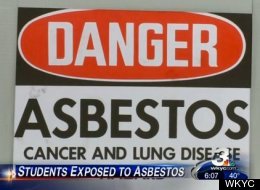
13 yr old students were some of the volunteers who helped clean up at an asbestos laden site
After attention was turned to this issue, the school has now indicated that it will use a certified asbestos abatement contractor instead.
Alaska company neglects to tell demolition workers about asbestos
Alaska co knew about asbestos, but asked employees to move forward with demolition
The names “Copper River Campus” and “Copper River Seafoods” conjure images of pure water running through a pristine natural setting. However, Copper River Campus, the facility and building owner of buildings for Copper River Seafoods was aware of asbestos in its walls, ceilings, floors and elsewhere in the structure that it purchased in 2009 in Anchorage, Alaska.
Despite its awareness, according to U.S. Attorney Karen Loeffler, CSR put its employees in danger by allowing them to be exposed to airborne asbestos fibers, known to cause mesothelioma and asbestosis. Ms. Loeffler stated that the CRS employee, the manager who gave the demolition instructions, did not know about the presence of asbestos. The employee did not recognize the presence of the material either and went ahead with the demolition, hence putting himself in danger of inhaling airborne asbestos fibers, which can cause asbestosis and mesothelioma.
Once the Environmental Protection Agency learned of the activity, they sent an inspector to the property. The inspector determined that “Copper River Campus negligently placed employees of Copper River Seafoods and others in imminent danger of serious bodily injury, as they had no specialized training on asbestos removal, nor were they wearing personal protective equipment.” Anyone involved may have suffered serious illness due to asbestos exposure, the inspector added.
Unfortunately, this is just one of many instances of an entity willfully disregarding the safety and health of its employees, in its failure to disclose and safeguard against exposure to harmful materials such as asbestos.
$9+ Million Verdict for Asbestos Injury Victim Thrown Out
From 1968 to 2001, Henry Barabin worked at the Crown-Zellerbach paper mill. Until 1984, Mr. Barabin routinely worked around dryer felts containing asbestos, supplied to plant by AstenJohnson Inc. and Scapa Dryer Fabrics Inc. He used the felts at work, and he also took pieces home to use in his garden, according to the Court.

Plaintiff Barabin worked for decades at a paper mill. Not until 2006 did he learn that he had mesolthelioma.
In 2006, Mr. Barabin was diagnosed with mesothelioma cancer.
He and his wife sued the two companies in the Western District of Washington. Initially, U.S. District Judge Robert Lasnik excluded industrial health expert Kenneth Cohen from testifying on behalf of the Barabins. Judge Lasnik had issues with Cohen’s “dubious credentials and his lack of expertise with regard to dryer felts and paper mills.” However, Judge Lasnik later changed his mind and allowed Mr. Cohen to testify.
A jury then ruled for Barabin and awarded $9.3 million in damages. AstenJohnson and Scapa moved for a new trial, arguing that the District Court should have waited to reverse itself after further assessing Cohen’s credentials in a Daubert hearing, named for the 1993 case Daubert v. Merrell Dow Pharm.
The District Court disagreed, but a three-judge appellate panel ruled Friday that the oversight was serious enough to prompt a new trial. For the panel, Judge Johnie Rawlinson wrote the decision, “None of the Daubert factors were considered. Instead, the Court allowed the parties to submit the experts’ unfiltered testimony to the jury.”
“On remand, the District Court dutifully will make a new Daubertdetermination,” she wrote. “If the court finds that the expert testimony is, indeed, reliable, what purpose is served by empaneling a new jury and conducting another lengthy trial the outcome of which likely will be identical to the one already concluded? Mukhtar answers that query by holding that we cannot trust a District Court not to succumb to ‘post-hoc rationalization.’ But we routinely trust district courts to reassess their earlier judgments in matters of more consequence than disputes over money. Regardless, I do not share Mukhtar’s lack of faith in our district courts. Were it not for Mukhtar, I would conditionally vacate the judgment and remand to the district court with instructions to make a new Daubert determination. If the expert testimony is reliable, then the original judgment should be re-entered. If the expert testimony is not reliable, then the court should preside over a new trial.”
Asbestos/60 Million Pounds of Debris Illegally Dumped On Farm
If you had 60 million pounds of debris with asbestos, where might you look to offload it? How about a farm? Better yet, how about one with wetlands and a river that runs through it? That way, the asbestos could soak through the wetlands and flow through the land via the river.

60 million lbs of construction debris dumped farm in Frankfort, N.Y. [Photo: Dept of Justice]
Well, that’s what Cross Nicastro and Dominick Mazza decided to do. Nicastro is the owner of a 28 acre farm in upstate New York. Mazza was an owner of a waste management company. Both got convicted earlier this month and face prison time and big fines. The debris was originally from a New Jersey industrial shredding machine. Asbestos was never removed from the debris.
Assistant U.S. Attorney General Ignacia Morena stated that the defendants had “flouted numerous federal laws designed to protect Americans from exposure to toxic materials when they dumped asbestos-contaminated waste into an area that included sensitive wetlands” in a statement.
EPA Pushes for Tougher Standards for Asbestos Cleanup
According to an Associated Press article, we may soon see tougher standards in place for federal cleanup of asbestos contamination. The proposed standard emerged after the EPA’s analysis of a Montana town revealed that even the smallest amounts of asbestos can result in lung problems. In Libby, MT, the Environmental Protection Agency concluded that trace amounts of asbestos dust had killed hundreds of people. To rid the area of that dust, the standard would need to be 5,000 times stricter than the standard used for previous cleanups.
A proposed standard for federal cleanup of asbestos contamination in a Montana town concludes that even a tiny amount of the material can lead to lung problems – a benchmark far more rigorous than any in the past and one that the industry says could force expensive and unnecessary cleanups across the country.
The Environmental Protection Agency’s new proposal for the northwest Montana town of Libby, where asbestos dust has killed hundreds of people, would be 5,000 times tougher than the standard used in past cleanups addressing airborne asbestos.
The Government Accountability Office has said the cleanup standard could impact about 200 or so industrial sites in 40 states that also received asbestos-tainted vermiculite from Grace’s Montana mine. More than 20 of those sites, posing the highest health risks, have already been cleaned once. Most of those were processing plants where the mineral was heated at high temperatures so it could expand and be used for insulation in millions of homes.
The GAO and asbestos experts said the EPA risk assessment could force more cleanups. And Grace representatives and health officials said the EPA proposal could apply to other types of asbestos found in communities across the country.
While companies such as Grace may understandably want to resist higher cleanup standards, the Fed’s focus is on curbing the number of asbestos related deaths and injuries.
No Knowledge About Mesothelioma Until It’s Too Late
 Asbestos related illnesses such as mesothelioma are particularly insidious because people often do not realize that they have the disease until decades after their exposure to asbestos. The severity of illness depends on how long the person was exposed and the amount inhaled.
Last week, the estate of a former New Mexico railroad employee sued BNSF Railway alleging wrongful death, due to asbestos exposure, of locomotive repair shop worker Santiago Riley. During 13 years of employment from 1942-1955 at railroad facilities in New Mexico and Arizona, Riley made locomotive repairs, performed various shop duties and swept floors around dusty asbestos-containing substances without any respiratory protection.
This exposure caused permanent injury and contributed to his eventual death, according to the lawsuit filed by his children. The estate seeks damages for mental and physical suffering, lost wages, medical bills and other financial losses.
An important takeaway of Santiago Riley’s story is that he and his family did not learn about his mesothelioma for years after this employment at BNSF.
Mesothelioma patients generally do not demonstrate symptoms of this disease until 20 to 50 years after their initial exposure to asbestos. Fibers that embed in the tissue surrounding the body’s internal organs, the mesothelium, usually must be present for many decades before the development of cancer. These fibers gradually accumulate and cause scarring, which leads to inflammation and cancer. Although these fibers are most often introduced into the body through inhalation, the material can also be introduced through ingestion as well. Initially, symptoms may be mild and an individual might not find them cause for alarm. However, as the cancer spreads, these symptoms become more severe and debilitating.
Recyling Company Sentenced to Pay Over $500K for Asbestos Dumps
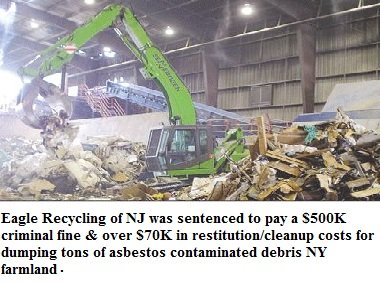 A recent Wall Street Journal article reports that Eagle Recyling, a New Jersey recycling company was sentenced to pay a $500K criminal fine and over $70K in restitution & cleanup costs. It was found dumping thousands of tons of asbestos contaminated construction debris in Central NY.
The company pleaded guilty earlier this year and agreed to comply with environmental laws.
According to the charges and plea agreement, Eagle Recycling and other co-conspirators engaged in a multi-year scheme to illegally dump 8,100 tons of pulverized construction and demolition debris that was processed at Eagle Recycling’s North Bergen solid waste management facility and then transported to a farmer’s property in Frankfort, N.Y. Eagle Recycling and other conspirators then concealed the illegal dumping by fabricating a New York State Department of Environmental Conservation (DEC) permit and forging the name of a DEC official on the fraudulent permit.
Peritoneal Mesothelioma Cancer Widow Speaks Out
A New Jersey widow, who recently settled for an undisclosed amount, spoke out about the death of her husband. According to court records, Randy Veraldo worked from 1978-85 as a parts handler at a Teterboro, N.J., warehouse. The job required him to unpack nautical clutch plates delivered on a near-daily basis from various suppliers. The clutch plates were said to contain asbestos, a mineral once widely used in the U.S. as a cheap insulating material but now known to cause.
Ms. Veraldo filed her lawsuit as the executrix of the estate of her late husband. He died in 2009, seven months after being diagnosed with periotoneal mesothelioma cancer.
An important takeway from this is the fact that someone who lost her loved one to a slow, but deadly disease found justice — even after many years of exposure at work to asbestos.
Prince William & Kate Middleton Shine a Light on Asbestos Abatement
 When I hear “major renovation,” I think of dust and hammering for months. This is likely what’s going on as part of the overhaul of the five-bedroom apartment at Kensington Palace in London, where Prince William and his new wife, Kate Middleton, will soon settle down.
However, first thing is first. Along with significant updates (the last renovation of the apartment was 1960), “Early indications suggest that large quantities of asbestos will have to be removed, as well as work on the heating and hot water systems and electrical wiring. The extent of the work needed to turn the apartment back into a home is not yet known, but it is expected that the apartment will not be ready for occupation until at least the middle of 2013.” This was a statement made to People magazine.
The presence of asbestos in William and Kate’s future home is gaining worldwide attention, especially given the rumors swirling about regarding the possibility that Kate is pregnant.
Back in 1960, during the last major renovation of Kensington Palace, asbestos use was widespread and nothing controversial. In fact, asbestos was the material of choice for flooring, ceiling tiles, and insulation for the Palace.
Back then, asbestos was a first choice as a material due to its heat and fire retardant properties. Before 1980, in construction projects and products manufactured, asbestos was incredibly popular.
Now, however, with the Palace renovation, many more people are learning about the importance of proper abatement and containment of this lethal substance.
Recent Mesothelioma News
Recent Mesothelioma News
Why Should Anyone Seek Justice as an Asbestos Victim?
The Wall Street Journal recently featured a fascinating story about an asbestos victim. Bill McQueen, unlike other mesothelioma patients that we often hear about, was not a shipbuilder or construction worker. He was an Air Force surgeon. Dr. McQueen had sought medical care, when his chest pain persisted. He had thought it was perhaps a flareup of an old rib fracture. However, is doctor ultimately told him that he was suffering from mesothelioma, an incurable and fatal cancer that was encasing his left lung.
Dr. McQueen represents a different type of plaintiff in the asbestos litigation. Rather than targeting one or two defendants, asbestos claims are now involving dozens of corporate defendants. Research based on asbestos filing in Philadelphia reveals that almost 50% of the mesothelioma claims from 2006 through 2010 related plaintiffs’ exposure due to do-it-yourself type of construction or auto mechanic projects. In contrast, those type of plaintiffs were only about 3% of similar claims in the prior decade (1991- 2001).
The mesothelioma was so far advanced for Dr. McQueen, when his wife began to search for an asbestos-injury attorney. In 2011, waking up from a coma, Dr. McQueen found an attorney at his bedside. The process of understanding how Dr. McQueen was exposed to asbestos began with digging through photos of an old family farm. Some of those photos showed rusty paint cans, cement bags, and insulation, all of which Dr. McQueen had worked with decades before. As a result, Dr. McQueen and his wife named over two dozen corporate defendants.
What is also interesting to see from this WSJ article is the comments. Some found the McQueens’ search for justice “disgusting,” while others viewed the claim as a sort of fishing expedition. A scant few seemed to recognize that this was the family’s attempt to hold negligent companies accountable.
Dr. McQueen passed away in his home this past March. Trial is set for this November, while several defendants have settled with the family already.
New Blood Test May Help ID Mesothelioma
Patients who believe that they may have mesothelioma may now have a new way of confirming their hunch via a blood test. US News & World Reports article earlier this month reported on the blood test, along with a lung fluid test. The lung fluid test looks for a protein in plasma called fibulin-3 that indicates whether a person has mesothelioma, often triggered by asbestos exposure.
The article quotes study author, Dr. Harvey Pass, a professor of thoracic oncology at NYU Langone Medical Center in New York City: “In the mesothelioma patients, fibulin-3 was four to five times higher than in asbestos-exposed individuals,”
Results of the study appear in the Oct. 11 issue of the New England Journal of Medicine.
This cancer originates in the lining of the heart, abdomen, chest, and lungs. Mesothelioma is a disease prevalent among individuals who have worked with asbestos or in locations where exposure to asbestos was likely. Smoking increases the risk of mesothelioma.
The deadly material has been used in manufacturing heat resistant materials, often used for construction/plumbing projects. Asbestos has also been used in automotive/truck parts–most notably the brake components, according to the U.S. Environmental Protection Agency.
Dr. Pass recognized that mesothelioma could take years, if not decades, to developer after asbestos exposure. Often, once diagnosed, mesothelioma patients would face grave prognoses of 1 year or less for survival. Symptoms are coughing, chest pain, and shortness of breath.
An earlier detection by use of a “biomarker” may allow for more effective treatment of mesothelioma.
Mesothelioma Victim Awarded $2.1 Million Verdict Against, Defeats Parts Manufacturer
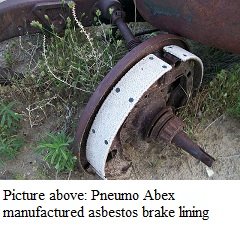 When James Lovelace was 10 years old, he loved to help his father, a big-rig truck driver, service his trucks. This included handling brake components that contained asbestos. Now 66 years old, Mr. Lovelace is a victim of the malignant cancer, mesothelioma.
The brake parts manufacturer, Pneumo Abex, said to the jury, that Lovelace was exposed to asbestos in a lot of other ways besides working with Abex brake parts. In other words, Defendant Abex’s claimed that it wasn’t the manufacturer’s fault that Lovelace suffered from mesothelioma. Rather, it pointed to the general exposure to the deadly material in his house. Through his childhood, Lovelace breathed and touched items that carried asbestos dust from his father’s workplace as a forklift operator at Johns Manville asbestos cement pipe plant in Stockton, CA.
After a three week trial, the jury did not buy much of Abex’s arguments. It turned around and awarded Mr. Lovelace $1 million for future noneconomic damages, $500,000 for past noneconomic damages; $430,000 for future economic damages; and $144,000 for past economic damages.
The SKWC asbestos injury attorneys congratulate Mr. Lovelace and his team of trial lawyers for this important victory.
Air Force Veteran with Mesothelioma Campaigns For Republican
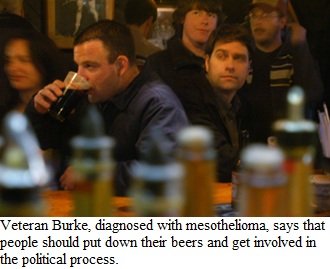 Diagnosed with mesothelioma a little more than 2 years ago, Patrick Burke at 55 had doctorstell him that he has a 10% chance to live 3 years. While he doesn’t know if he’ll survive to see the 2012 presidential election results, he won’t let the deadly disease stop him from campaigning for his candidate of choice, Rick Perry. According to the Fort Worth Star-Telegram, Burke devoted the past week in support of Perry in Iowa.
From Texas, Burke is a former Air Force veteran. To campaign for Perry was something on Burke’s “bucket list.”
When interviewed by the Telegram, Burke explained that he thought that all citizens had a duty to get involved in the political process, “I tell everybody to put down their beer and stop watching The Simpsons.’
Sadly, about 33% of mesothelioma patients are veterans who were exposed to asbestos while in service. Then, after they left the Air Force, they frequently took jobs that further exposed them to asbestos. This extended exposure inevitably led to countless diagnoses of mesothelioma.
Woman dies from washing husband’s asbestos laden clothes
The Sun Newspaper in the UK reports a woman died from inhaling deadly asbestos dust after years of washing her husband’s work clothes. An inquest as to the cause of death heard she shook out her carpenter Dennis’s overalls before washing — freeing particles of the deadly material asbestos. The local coroner recorded a verdict of death from an industrial disease.
She contracted the asbestos-related disease mesothelioma last June and died last month. Her husband is also ill and receiving medical treatment.
New Drug for Mesothelioma
Medical News Today recently reported the FDA has approved a new drug used to treat malignant pleural mesothelioma, a rare cancer usually associated with asbestos exposure. The drug is called Alimta, or pemetrexed disodium, and it’s distributed by Eli Lilly and Company. Alimta is intended to be used along with cisplatin.
It’s further reported in a randomized clinical trial, patients receiving Alimta along with cisplatin lived an average of 12 months after the trial began, compared with nine months for those on cisplatin alone.
European study finds drug effective in treatment of mesothelioma
Reuters reports that the COX-2 inhibitor Celebrex, usually prescribed for arthritis, has a marked effect on the asbestos-related cancer malignant mesothelioma in lab and animal experiments, according to a report from Italy.
Recent Legal Cases
Recent Legal Cases
Why Should Anyone Seek Justice as an Asbestos Victim?
The Wall Street Journal recently featured a fascinating story about an asbestos victim. Bill McQueen, unlike other mesothelioma patients that we often hear about, was not a shipbuilder or construction worker. He was an Air Force surgeon. Dr. McQueen had sought medical care, when his chest pain persisted. He had thought it was perhaps a flareup of an old rib fracture. However, is doctor ultimately told him that he was suffering from mesothelioma, an incurable and fatal cancer that was encasing his left lung.
Dr. McQueen represents a different type of plaintiff in the asbestos litigation. Rather than targeting one or two defendants, asbestos claims are now involving dozens of corporate defendants. Research based on asbestos filing in Philadelphia reveals that almost 50% of the mesothelioma claims from 2006 through 2010 related plaintiffs’ exposure due to do-it-yourself type of construction or auto mechanic projects. In contrast, those type of plaintiffs were only about 3% of similar claims in the prior decade (1991- 2001).
The mesothelioma was so far advanced for Dr. McQueen, when his wife began to search for an asbestos-injury attorney. In 2011, waking up from a coma, Dr. McQueen found an attorney at his bedside. The process of understanding how Dr. McQueen was exposed to asbestos began with digging through photos of an old family farm. Some of those photos showed rusty paint cans, cement bags, and insulation, all of which Dr. McQueen had worked with decades before. As a result, Dr. McQueen and his wife named over two dozen corporate defendants.
What is also interesting to see from this WSJ article is the comments. Some found the McQueens’ search for justice “disgusting,” while others viewed the claim as a sort of fishing expedition. A scant few seemed to recognize that this was the family’s attempt to hold negligent companies accountable.
Dr. McQueen passed away in his home this past March. Trial is set for this November, while several defendants have settled with the family already.
L.A. Court Returns $26.6 Million Verdict to Former Drywaller
Last month, a Los Angeles Superior Court jury returned its verdict awarding $26.6 million to Michael Sutherland, a former drywaller, diagnosed with mesothelioma, a cancer caused by asbestos. and his wife Suszi.
As a drywaller in northern San Diego County from 1967, Mike was still attending Madison High School. Then, through 1993, he often took extended surfing trips to Hawaii and Mexico. As a contractor, he made a living for numerous residential and commercial jobs during the construction “boom” in the 1970s. During this period, cancer-causing asbestos was a common ingredient in popular construction products. Such products include joint compound, fire-rated drywall, caulk, stucco, roofing mastic and asbestos cement pipe.

“With all the trades working on top of each other trying to finish one job and move on to the next, it was always dusty,” Mike recalled, “It wasn’t until I became a lead maintenance mechanic at UC San Diego and attended a class on job safety in 2003 that I learned that so many of the materials used on the jobs back then contained asbestos.”
The Sutherlands’ case (LASC case # BC486980) was filed on June 20, 2012. Over 30 defendants were named in the case. They had settled most of the defendants before trial. However, Stucco manufacturer, Highland Stucco and Lime Products, Inc., refused to settle. Thus, Highland was the only defendant at trial, claiming that other companies and even Mr. Sutherland himself were responsible for his exposure to asbestos. Disagreeing with Highland, the jury ultimately found the company responsible for its role in subjecting Mr. Sutherland and other members of the public to its dangerous products.
What’s in Store for Asbestos Cases?
A good indicator of the future of asbestos lawsuits is what have seen so far in the past few years. According to one report, “Mesothelioma Trends in the United States: An Update Based on Surveillance, Epidemiology, and End Results Program Data for 1973 through 2003.” by Bertram Price and Adam Ware, (Am. J. of Epidemiol 2004; 159:107-112), mesothelioma diagnoses are reaching new highs. According to NERA Economic Consulting, there was a 75% increase in the average dollar amount for resolved claims in 2010. That number was more than double than then in 2009 and 2010. A large factor is that there were more malignancies resolved as opposed to non-malignancies. In general, however, the number of new cases remains stable, at about 52,000 new case per year.
Interestingly, there were less dismissed and resolved claims in 2011. This may be because the larger defendants have gone through the bulk of their non-malignant claims.
SCOTUS Pulls Plug on Plaintiffs’ Right to Asbestos Injury Claims Against Railroads
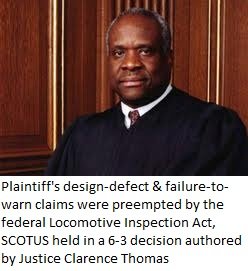 The U.S. Supreme Court has rejected a legal theory that would have given asbestos injury attorneys a new industry to attack with lawsuits.
SCOTUS ruled this past Wednesday in favor of companies involved with the design and manufacture of locomotives and their parts. The estate of the late George Corson, a welder and machinist for a railroad carrier, had sued Railroad Friction Products Corp. and Viad Corp. in Philadelphia, alleging injury from exposure to asbestos in trains and train parts distributed by the companies.
The estate’s design-defect and failure-to-warn claims were preempted by the federal Locomotive Inspection Act, the court held in a 6-3 decision authored by Justice Clarence Thomas. The decision was in line with one made by the court 85 years ago in Napier v. Atlantic Coast Line.
“(P)etitioners contend that the LIA’s preemptive scope does not extend to state common-law claims, as opposed to state legislation or regulation,” Thomas wrote.
“Napier, however, held that the LIA ‘occup(ied) the entire field of regulating locomotive equipment’ to the exclusion of state regulation. That categorical conclusion admits of no exception for state common-law duties and standards of care.”
The decision affirmed a ruling by the U.S. Court of Appeals for the Third Circuit. It had been removed from a state court to Philadelphia federal court.
Dissenting were justices Sonia Sotomayor, Ruth Bader Ginsburg and Stephen Breyer. Sotomayor’s dissenting opinion said that the plaintiffs’ claim for failure to warn was not preempted, though it agreed the defective design claim was.
The federal government and the American Association for Justice were among the groups supporting the plaintiffs’ lawsuit.
“Because the right to a legal remedy for wrongful injury is a fundamental right under the Constitution, courts may not preempt such a cause of action and leave injured persons without remedy unless Congress specifically intended that result,” the AAJ’s amicus brief said.
“The mere silence of Congress in a statute not directed at railroads rather than manufacturers falls short.”
Complaints against 50 other companies were dismissed.
Mississippi high court rejects asbestos company claims against tobacco makers
The Associated Press reports the Mississippi Supreme Court ruled that Owens Corning has no claim against tobacco companies over asbestos-related lung injuries. Owens Corning was trying to recover billions of dollars paid out in asbestos settlement cases by arguing the tobacco industry shared some of the blame for the health problems.
Appeals Court Orders Judge to Step Aside in Three Asbestos Cases
The New York Times reports a federal appeals court ordered the judge overseeing five important asbestos-related bankruptcy proceedings to withdraw from three of the cases because of the appearance of bias. In a 2-to-1 decision, a panel of the United States Court of Appeals for the Third Circuit in Philadelphia ordered Alfred M. Wolin, a federal district judge in Newark, to end his role in the bankruptcy hearings involving W. R. Grace, Owens Corning and U.S. Gypsum because his handling of the cases had the appearance of bias.
Fort Worth Custodian has no choice but to sue
The Dallas Fort Worth Star-Telegram presented a heart moving story of another asbestos victim in Sunday’s May 2 paper. The paper further reports school maintenance workers may be at increased risk for developing diseases related to prolonged exposure to asbestos.
Reading the story, your heart has to go out to this custodian worker:
As Randall Blevins was recovering from surgery, doctors told his wife that the patches indicated exposure to significant amounts of asbestos. Presumably, they said, the right lung was the same.
That was May 2002, 25 years after Blevins began working as a heating and air-conditioning technician for the Fort Worth school district. He fixed boilers and repaired pipes — products often encased in asbestos.
Blevins, 50, believes that his lung disease stemmed from his work for the district because he knows of no other contact with asbestos dust.
From 1977, when he was hired, until about 1982, when the district stepped up its precautions, he handled asbestos without thinking. Blevins said he and the district’s other boiler-room workers hit it with their wrenches and ripped it off pipes with their bare hands while crawling under buildings. Each time, the white shards cascaded into their hair, eyes, noses and mouths.
“We would handle asbestos like it was nothing,” said Blevins, who lives in Southlake. “Might have on only paper masks.”
Blevins said he appears to be the only one in his maintenance team who has been diagnosed with asbestos-related symptoms. But asbestos illnesses typically don’t show up until decades later, and Blevins’ illness gives some of his co-workers pause.
“I look at him and think, ‘That could be me,’ ” said Arthur Cox, the district’s heating and air-conditioning foreman.
Texas Judge denies request to postpone lawsuits
A Texas judge has rejected requests by companies being sued for asbestos poisoning to create a separate docket dealing only with cases in which plaintiffs are sick. The companies wanted to delay all other cases until the victim developed asbestos-related sicknesses. Lawyers for the plaintiffs said the delays would deny their clients constitutional access to the courts and a trial by jury.
This was reported by the Star-Telgram quoting a portion of Judge Davidson’s findings: “At some point in the future, the number of cases filed which could qualify for assignment to an unimpaired docket could result in a denial of right to court access to other cases in which impairment is agreed to exist. It cannot be said that this is the case at this time for cases filed since Sept. 1, 2003.”
It was also reported more than 600,000 asbestos-related lawsuits have been filed nationwide, many by people who have not developed symptoms of asbestos-related illness. About a third of those were filed in Texas.
Illinois Judge Hands Over Asbestos Docket
An Illinois circuit judge facing scrutiny from pro-business and pro-industry groups handed over his docket, asking that his county’s asbestos lawsuits be handled by another judge, according to a recent article in the Belleville News-Democrat.
Nicholas Byron ruled the Madison County Circuit Court that handles the country’s largest asbestos docket for about 10 years. In 2003 alone, he presided over 953 such cases. As a result, Madison County is notorious for its plaintiff-friendly reputation.
Recent Asbestos News
Recent Asbestos News
EPA Slaps a Fine on DOE Contractor
The Department of Energy, which oversees the Hanford Nuclear cleanup in Eastern Washington, got slapped with a $115,000 fine for violations in its asbestos disposal. The U.S. Environmental Protection Agency (EPA) announced earlier this week that its inspectors at the Hanford Nuclear Reservation found improperly managed asbestos in 19 of 22 samples taken at demolition sites.
Based on samples taken at six demolition areas, the EPA said waste containing asbestos was improperly disposed at a Hanford waste facility and there may be as many as 35 more sites where asbestos has, or is suspected to have been, released to the soil.
According to an NPR report by Anna King
EPA fines DOE for improper asbestos removal.
the alleged violations occurred during building demolitions in 2009 and 2010 when federal stimulus money sped up deconstruction projects.
Dennis Faulk, a manager with the EPA, says the federal contractor failed to document and label truck shipments of asbestos debris.
The Hanford cleanup which includes the demolition of hundreds of buildings at the site, which processed materials for construction of nuclear weapons for World War II and the Cold War.
L.A. Court Returns $26.6 Million Verdict to Former Drywaller
Last month, a Los Angeles Superior Court jury returned its verdict awarding $26.6 million to Michael Sutherland, a former drywaller, diagnosed with mesothelioma, a cancer caused by asbestos. and his wife Suszi.
As a drywaller in northern San Diego County from 1967, Mike was still attending Madison High School. Then, through 1993, he often took extended surfing trips to Hawaii and Mexico. As a contractor, he made a living for numerous residential and commercial jobs during the construction “boom” in the 1970s. During this period, cancer-causing asbestos was a common ingredient in popular construction products. Such products include joint compound, fire-rated drywall, caulk, stucco, roofing mastic and asbestos cement pipe.
“With all the trades working on top of each other trying to finish one job and move on to the next, it was always dusty,” Mike recalled, “It wasn’t until I became a lead maintenance mechanic at UC San Diego and attended a class on job safety in 2003 that I learned that so many of the materials used on the jobs back then contained asbestos.”
The Sutherlands’ case (LASC case # BC486980) was filed on June 20, 2012. Over 30 defendants were named in the case. They had settled most of the defendants before trial. However, Stucco manufacturer, Highland Stucco and Lime Products, Inc., refused to settle. Thus, Highland was the only defendant at trial, claiming that other companies and even Mr. Sutherland himself were responsible for his exposure to asbestos. Disagreeing with Highland, the jury ultimately found the company responsible for its role in subjecting Mr. Sutherland and other members of the public to its dangerous products.
Boeing Sidesteps Asbestos Claim
At a Boeing hammer shop, white powder was flaking and falling from overhead pipes. So maintenance workers re-wrapped the overhead pipes to contain the absestos insulation. These workers wore protective clothing that the hammer shop workers called “moon suits.” But those hammer shop workers, including Gary Walston, did not wear any protective clothing or respirators. While the moon suited workers wrapped the pipes, visible dust and debris fell on Gary Walston and his colleagues. To protect their tools from accumulating dust, they covered them with plastic. When Gary asked his supervisor if he could wear protective gear too, he was told “get back to work.”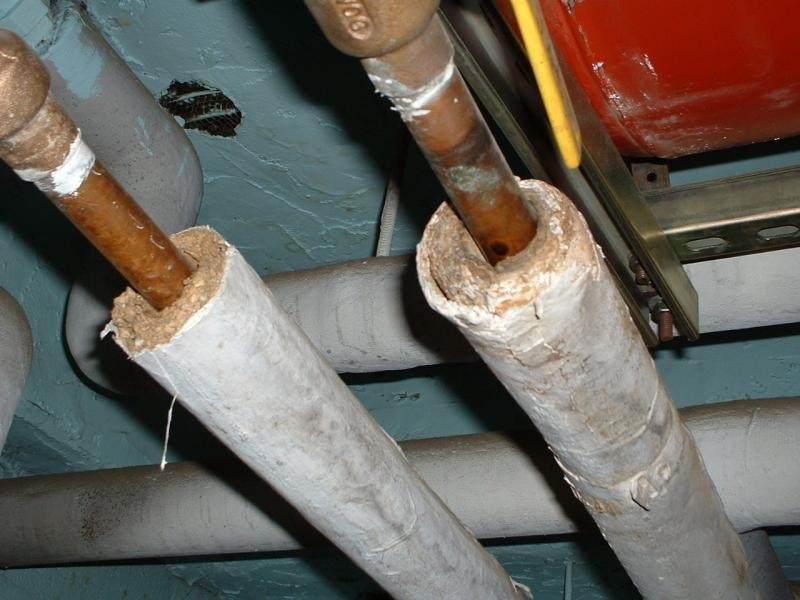
Roughly 25 years later, Gary Walston was diagnosed with mesothelioma. He sued Boeing, his employer, alleging that he contracted mesothelioma as a result of his exposure to asbestos while working at the hammer shop. The trial court denied Boeing’s motion for summary judgment, and Boeing appealed.
Despite the fact Boeing’s previous involvement in workers’ compensation claims with claimants suffering from asbestos-related injuries, Boeing denied that it had any “actual knowledge” that Mr. Walston’s injuries would be “certain” as a result of the visible asbestos in the hammer shop.
Mr. Walston claimed that he presented evidence raising a material factual dispute about whether Boeing had (1) actual knowledge that he was certain to be injured and (2) that Boeing willfully disregarded such knowledge. Mr. Walston argued that he—like the employees in Birklid, Hope, and Baker—was injured as a result of being exposed to a substance at work that his employer knew was certain to injure him.
The three panel appellate court reversed the trial court’s denial of Boeing’s MSJ. Judge Marywave Van Deren wrote that Boeing workers like Mr. Walston “were not immediately or visibly injured by the exposure to asbestos.” “Nor did they complain of injuries caused from their exposure to asbestos. Walston was not diagnosed with an asbestos related disease until 25 years after the ‘moon suit incident’ in the hammer shop.”
What this ruling shows is that asbsestos injury lawyers have a steep hill to climb to educate judges and the larger public about the extreme hazards of asbestos exposure. Simply because someone is not immediately coughing or showing visible injury does not mean that their bodies have already been exposed to dangerous amounts of asbestos. Mesothelioma and other asbestos related injuries can take decades to detect, as illustrated by Gary Walston’s case. If you are ever in a situation such as Mr. Walston, please think about the longterm consequences and do everything you can to educate your employer. Keep a written journal and records of all written correspondence. Hopefully, however, you will not need these in a claim against your employer.
Alaska company neglects to tell demolition workers about asbestos
Alaska co knew about asbestos, but asked employees to move forward with demolition
The names “Copper River Campus” and “Copper River Seafoods” conjure images of pure water running through a pristine natural setting. However, Copper River Campus, the facility and building owner of buildings for Copper River Seafoods was aware of asbestos in its walls, ceilings, floors and elsewhere in the structure that it purchased in 2009 in Anchorage, Alaska.
Despite its awareness, according to U.S. Attorney Karen Loeffler, CSR put its employees in danger by allowing them to be exposed to airborne asbestos fibers, known to cause mesothelioma and asbestosis. Ms. Loeffler stated that the CRS employee, the manager who gave the demolition instructions, did not know about the presence of asbestos. The employee did not recognize the presence of the material either and went ahead with the demolition, hence putting himself in danger of inhaling airborne asbestos fibers, which can cause asbestosis and mesothelioma.
Once the Environmental Protection Agency learned of the activity, they sent an inspector to the property. The inspector determined that “Copper River Campus negligently placed employees of Copper River Seafoods and others in imminent danger of serious bodily injury, as they had no specialized training on asbestos removal, nor were they wearing personal protective equipment.” Anyone involved may have suffered serious illness due to asbestos exposure, the inspector added.
Unfortunately, this is just one of many instances of an entity willfully disregarding the safety and health of its employees, in its failure to disclose and safeguard against exposure to harmful materials such as asbestos.
Superstorm Sandy Brings Asbestos Woes
The victims of Superstorm Sandy have seen enormous loss and devastation. Now, survivors need to recognize the risks of asbestos exposure.
The storm has claimed over 100 lives in the U.S.–mostly in New York, New Jersey and Pennsylvania. Over a hundred houses and housing units were destroyed, as witnessed by many news reporters throughout the New York/New Jersey area. We are talking about $62 billion and counting in damage and other losses in the country because of this latest storm.

Massive construction debris from Superstorm Sandy likely means thousands of tons of asbestos laden debris. (AP Photo)
To put Superstorm Sandy in perspective, Hurricane Katrina in 2005 left $128 billion damage in its wake, adjusted for inflation in 2012 dollars. In the Caribean, Sandy left no less than $315 million in damage.
A 2011 tornado in small town Joplin, Missouri left behind 2,600 tons of asbestos debris.
Contrast that one little community with all of the large communities, including the greater Manhattan area and the sizable New Jersey cities hit by Sandy. Linda Reinstein, president of the nonprofit Asbestos Disease Awareness Organization. “Do the math, and we can recognize that we have a significant public health risk with Hurricane Sandy.”
Along with schools and buildings, thousands of houses have water and wind damage, causing a spike in risks of exposure to various toxins. Asbestos related injury is one of the greatest concerns. Construction debris and waste likely contain microscopic asbestos fibers. Because these particles are virtually impossible to detect to the naked eye, people can unwittingly breathe it and ingest it. After time, mesothelioma or other severe medical conditions is a common result.
New Blood Test May Help ID Mesothelioma
Patients who believe that they may have mesothelioma may now have a new way of confirming their hunch via a blood test. US News & World Reports article earlier this month reported on the blood test, along with a lung fluid test. The lung fluid test looks for a protein in plasma called fibulin-3 that indicates whether a person has mesothelioma, often triggered by asbestos exposure.
The article quotes study author, Dr. Harvey Pass, a professor of thoracic oncology at NYU Langone Medical Center in New York City: “In the mesothelioma patients, fibulin-3 was four to five times higher than in asbestos-exposed individuals,”
Results of the study appear in the Oct. 11 issue of the New England Journal of Medicine.
This cancer originates in the lining of the heart, abdomen, chest, and lungs. Mesothelioma is a disease prevalent among individuals who have worked with asbestos or in locations where exposure to asbestos was likely. Smoking increases the risk of mesothelioma.
The deadly material has been used in manufacturing heat resistant materials, often used for construction/plumbing projects. Asbestos has also been used in automotive/truck parts–most notably the brake components, according to the U.S. Environmental Protection Agency.
Dr. Pass recognized that mesothelioma could take years, if not decades, to developer after asbestos exposure. Often, once diagnosed, mesothelioma patients would face grave prognoses of 1 year or less for survival. Symptoms are coughing, chest pain, and shortness of breath.
An earlier detection by use of a “biomarker” may allow for more effective treatment of mesothelioma.
Asbestos Epoch at the Capitol Ends $173 Million Later
 This week, the Huffington Post reports on the official conclusion of an epoch battle related to asbestos found in the Capitol Hill underground system. Employees who had been exposed to asbsestos for years
The Office of Compliance (OOC) closed out the administrative complaint it filed six years ago. The complaint included claims against the Architect of the Capitol (AOC) for its failure to eliminate safety and health hazards found in 2000. Excessive asbestos and heat as well as falling concrete were cited as hazards that had been discovered over a decade ago in the underground tunnel that provides steam and chilled water to Capitol Hill.
After well over $100 million, the OOC is content in AOC’s fulfillment of its obligations.
However, workers who continue to suffer from the years of exposure to asbestos do not find much to be happy about with the conclusion of OOC’s complaint. They point out that it took about six years from the time when the hazards were revealed before the OOC did anything.
The OOC’s general counsel, Eveleth, said, “Filing the complaint sent a message that we will not put people’s lives at risk in circumstances when employing offices offer no viable solution for abating a very serious hazard.”
Waiting To Exhale at a Brooklyn School
A public school’s plans for asbestos abatement have the parents at Cobble Hill Elementary, a public school in Brooklyn ready to occupy the school until their claims are met. Parents were upset, when the school provided little notice about the plans to remove asbestos from the school structure.
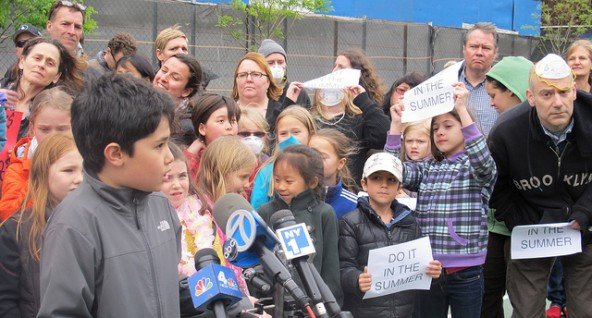
Rather than conduct the abatement while the school children are on spring or summer break, the plan is to remove the asbestos after hours each school day. The concern is that the dust produced from the abatement project will needlessly expose the children to harmful fibers known to cause cancer and other serious illnesses.
This Friday, if the school does not change its plan, parents vow to sit in and occupy the school in protest and to prevent the start of this controversial project mid-school year.
Hanford Workers Get Additional Protection from Asbestos
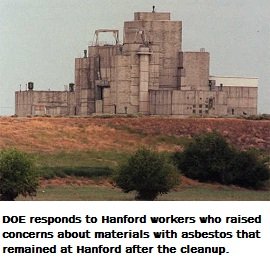 In today’s Tri-City Herald, an article reported that the Department of Energy (DOE) is taking additional measures to protect Hanford workers from asbestos. It is heartening to see that the DOE responded to the many workers’ questions and concerns about their safety in Central Hanford.
This past Thursday, union officials and top Hanford officials communicated to all Hanford staff, explaining the steps that they have taken and will take to protect workers from additional asbestos exposure. Hanford employees had expressed worries over materials that containued asbestos but were not yet demolished during the environmental cleanup.
A number of the buildings at Hanford were built with asbestos laden materials pre 1976. Workers, however, voiced concerns about breathing in asbestos fibers that could cause cancer, lung diseases, and other serious illnesses that could go undetected for decades after exposure.
Students Removed From Chicago Suburb School Due to Asbestos Scare
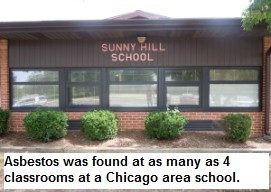 While replacing equipment at Sunny Hill Elementary School in Carpentersville, IL (outside of Chicago), workers identified asbestos in the glue that was used to mount whiteboards.
Officials say the asbestos at Sunny Hill Elementary in Carpentersville was “most likely” not airborne and students were not exposed to it.
“The good news is that the asbestos was not airborne at any time and can be completely and safely contained by putting up new drywall and repainting the four classrooms,” Superintendent Tom Leonard said in a letter to parents.
Thanks to the alert and well trained crew who identified the asbestos in time, to contain the dangerous substance before endangering the health of the students and staff at that school.
Products With Asbestos
Products With Asbestos
Why Should Anyone Seek Justice as an Asbestos Victim?
The Wall Street Journal recently featured a fascinating story about an asbestos victim. Bill McQueen, unlike other mesothelioma patients that we often hear about, was not a shipbuilder or construction worker. He was an Air Force surgeon. Dr. McQueen had sought medical care, when his chest pain persisted. He had thought it was perhaps a flareup of an old rib fracture. However, is doctor ultimately told him that he was suffering from mesothelioma, an incurable and fatal cancer that was encasing his left lung.
Dr. McQueen represents a different type of plaintiff in the asbestos litigation. Rather than targeting one or two defendants, asbestos claims are now involving dozens of corporate defendants. Research based on asbestos filing in Philadelphia reveals that almost 50% of the mesothelioma claims from 2006 through 2010 related plaintiffs’ exposure due to do-it-yourself type of construction or auto mechanic projects. In contrast, those type of plaintiffs were only about 3% of similar claims in the prior decade (1991- 2001).
The mesothelioma was so far advanced for Dr. McQueen, when his wife began to search for an asbestos-injury attorney. In 2011, waking up from a coma, Dr. McQueen found an attorney at his bedside. The process of understanding how Dr. McQueen was exposed to asbestos began with digging through photos of an old family farm. Some of those photos showed rusty paint cans, cement bags, and insulation, all of which Dr. McQueen had worked with decades before. As a result, Dr. McQueen and his wife named over two dozen corporate defendants.
What is also interesting to see from this WSJ article is the comments. Some found the McQueens’ search for justice “disgusting,” while others viewed the claim as a sort of fishing expedition. A scant few seemed to recognize that this was the family’s attempt to hold negligent companies accountable.
Dr. McQueen passed away in his home this past March. Trial is set for this November, while several defendants have settled with the family already.
Boeing Sidesteps Asbestos Claim
At a Boeing hammer shop, white powder was flaking and falling from overhead pipes. So maintenance workers re-wrapped the overhead pipes to contain the absestos insulation. These workers wore protective clothing that the hammer shop workers called “moon suits.” But those hammer shop workers, including Gary Walston, did not wear any protective clothing or respirators. While the moon suited workers wrapped the pipes, visible dust and debris fell on Gary Walston and his colleagues. To protect their tools from accumulating dust, they covered them with plastic. When Gary asked his supervisor if he could wear protective gear too, he was told “get back to work.”
Roughly 25 years later, Gary Walston was diagnosed with mesothelioma. He sued Boeing, his employer, alleging that he contracted mesothelioma as a result of his exposure to asbestos while working at the hammer shop. The trial court denied Boeing’s motion for summary judgment, and Boeing appealed.
Despite the fact Boeing’s previous involvement in workers’ compensation claims with claimants suffering from asbestos-related injuries, Boeing denied that it had any “actual knowledge” that Mr. Walston’s injuries would be “certain” as a result of the visible asbestos in the hammer shop.
Mr. Walston claimed that he presented evidence raising a material factual dispute about whether Boeing had (1) actual knowledge that he was certain to be injured and (2) that Boeing willfully disregarded such knowledge. Mr. Walston argued that he—like the employees in Birklid, Hope, and Baker—was injured as a result of being exposed to a substance at work that his employer knew was certain to injure him.
The three panel appellate court reversed the trial court’s denial of Boeing’s MSJ. Judge Marywave Van Deren wrote that Boeing workers like Mr. Walston “were not immediately or visibly injured by the exposure to asbestos.” “Nor did they complain of injuries caused from their exposure to asbestos. Walston was not diagnosed with an asbestos related disease until 25 years after the ‘moon suit incident’ in the hammer shop.”
What this ruling shows is that asbsestos injury lawyers have a steep hill to climb to educate judges and the larger public about the extreme hazards of asbestos exposure. Simply because someone is not immediately coughing or showing visible injury does not mean that their bodies have already been exposed to dangerous amounts of asbestos. Mesothelioma and other asbestos related injuries can take decades to detect, as illustrated by Gary Walston’s case. If you are ever in a situation such as Mr. Walston, please think about the longterm consequences and do everything you can to educate your employer. Keep a written journal and records of all written correspondence. Hopefully, however, you will not need these in a claim against your employer.
Superstorm Sandy Brings Asbestos Woes
The victims of Superstorm Sandy have seen enormous loss and devastation. Now, survivors need to recognize the risks of asbestos exposure.
The storm has claimed over 100 lives in the U.S.–mostly in New York, New Jersey and Pennsylvania. Over a hundred houses and housing units were destroyed, as witnessed by many news reporters throughout the New York/New Jersey area. We are talking about $62 billion and counting in damage and other losses in the country because of this latest storm.
Massive construction debris from Superstorm Sandy likely means thousands of tons of asbestos laden debris. (AP Photo)
To put Superstorm Sandy in perspective, Hurricane Katrina in 2005 left $128 billion damage in its wake, adjusted for inflation in 2012 dollars. In the Caribean, Sandy left no less than $315 million in damage.
A 2011 tornado in small town Joplin, Missouri left behind 2,600 tons of asbestos debris.
Contrast that one little community with all of the large communities, including the greater Manhattan area and the sizable New Jersey cities hit by Sandy. Linda Reinstein, president of the nonprofit Asbestos Disease Awareness Organization. “Do the math, and we can recognize that we have a significant public health risk with Hurricane Sandy.”
Along with schools and buildings, thousands of houses have water and wind damage, causing a spike in risks of exposure to various toxins. Asbestos related injury is one of the greatest concerns. Construction debris and waste likely contain microscopic asbestos fibers. Because these particles are virtually impossible to detect to the naked eye, people can unwittingly breathe it and ingest it. After time, mesothelioma or other severe medical conditions is a common result.
Widow of SeaTac Worker Awarded $475K for Asbestos Related Injury & Death
Donald Potts worked at SeaTac Airport for a major construction project between 1970 and 1972. During that time, his wife Lorena claims, he inhaled airborne asbestos particles. In November 2012, his doctor diagnosed him with mesothelioma, an asbestos related cancer. At 71 years old, he passed away on January 13, 2011. Later that year, his wife and the Estate of Donald Potts commenced trial against the Port of Seattle.
However a few weeks ago, the Port of Seattle Board of Commissioners decided that they would save the Port money by settling with the plaintiffs for $475,000.
In the past several decades, at minimum two other cases involve the Port for penalties related to hazardous asbestos exposure at SeaTac.
What is interesting and important to note about the Potts case is that the alleged exposure dates back to the early 1970’s with a relatively recent diagnosis and death of the mesothelioma patient. This suggests that other victims of asbestos exposure have issues ripe for litigation.
Asbestos Warning Signs Alarm Residents
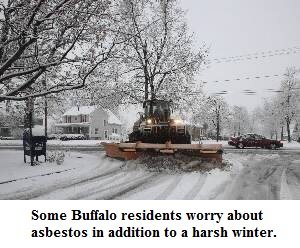 An article came out today in BuffaloNews.com about a story that could happen anywhere in this country.
Asbestos warning signs were posted recently at Marine Drive Apartments. No explanation was provided, which naturally caused a number of residents to wonder about their health and safety.
Housing Authority officials said a state mandate from the Office of Public Employee Safety and Health dictated when and where the signs were to be placed. The mandate did not allow time to inform residents before they went up.
Plans to hold a public informational meeting are in the works, they said.
“We’re not trying to inflame residents,” said Dawn E. Sanders, executive director of the Buffalo Municipal Housing Authority, which owns and manages the Marine Drive complex. “We didn’t have time before signs were put up to have a meeting with residents. The PESH report said we had to put up signs immediately, and that was the soonest we could have put them up. We didn’t randomly pick where to put them.”
The notices read, “Danger. Asbestos Cancer and Lung Disease Hazard. Authorized Personnel Only.” They were posted late last Friday afternoon at the elevators and the front and back doors of each of the seven buildings of the waterfront complex.
Problems began in August, when seven workers at Marine Drive removed asbestos around eight water valves to address a leaking problem. A state agency investigation determined that the employees had not followed proper rules for dealing with asbestos, and the Housing Authority was handed 17 citations. One of the required corrections involved posting asbestos-warning signs in specific areas.
The warnings also noted that confirmed or presumed asbestos- containing materials are present throughout the building, including floor tile, linoleum, plaster ceilings, heating pipes and all interior and exterior caulking.
The information had some residents worried about whether the affected areas included their individual units.
Only common areas, the boiler room and the maintenance room are affected, said Assistant Executive Director Modesto Candelario.
The good news is that most of the affected areas have already had abatement work done. Morever, residents will not have to be relocated, he added, because the abatement “won’t be done in their apartments.”
Products Distributor Warns Of Asbestos Gaskets
According to Financial Times, Wolsely, the plumbing and heating products distributor, has warned some customers in the US and Canada that it may have inadvertently sold them asbestos gaskets.
Following two years of internal investigations, the company disclosed the problem regarding these gaskets today. The company expects legal action to result.
The problem with the parts, used as plumbing seals, was disclosed on Tuesday after two years of internal investigations. It is expected to lead to legal action.
Wolseley reported that four customers in the US and Canada found that the supposedly asbestos-free gaskets contained more than 1% asbestos, the threshold at which the products are required to have a label that it contains the dangerous substance.
The company blames the former Canadian supplier, Lortech rubber.
Ian Meakins, Wolseley CEO, says that it plans to sue Lortech. He also mentioned that he expects that several customers will file action against Wolseley.
Key Asbestos Product Liability Case Awaits CA Supreme Court Decision
 Earlier this month, the California Supreme Court heard oral argument in O’Neil v. Crane Co. How the CA Supreme Court decides the case will likely either expand or limit the duty of the product manufacturers to warn about the hazards of replacement parts that others made but that are then incorporated by the purchaser in the manufacturer’s original product.
O’Neil is a case about a plaintiff’s exposure to asbestos-containing gaskets and packing materials used in and around Crane Co’s valves and pumps, which the Navy incorporated into the steam propulsion system aboard the USS Oriskany. The plaintiff had served on the Oriskany while he was enlisted.
Though the pumps and valves delivered to the Navy originally incorporated asbestos-containing gaskets and packing, all parties agreed that by the time plaintiff served aboard the Oriskany, the original asbestos packing and gaskets had been removed and replaced with packing and gaskets manufactured by third parties. Nevertheless, the plaintiff argued the pump and valve manufacturers had a duty to warn him regarding the hazards of asbestos.
The Court did not appear to sit well with the proposition that the pumps and valves could be deemed defectively designed if the pumps and valves were “asbestos neutral,” and could function just as well in other systems utilizing non-asbestos containing materials.
This may be a large focus for the court with regard to assigning a duty to warn about replacement parts made by others only if the replacement part is identical to the original hazardous part, and the replacement part is essential to the function of the defendant’s product. We await the decision, which will come out in about two and a half months from today.
More on Exposure in Washington – The Railroad Industry
 In the Pacific Northwest, the railroad industry has been strong and active. Many national Railroads, such as the Union Pacific and Burlington Northern Santa Fe Railroads have had a long history in both Washington and Oregon. That history has included not only the motive of rail cars within Washington and Oregon, but, also the maintenance and repair of locomotives, as well as, rail cars, rail equipment and machinery.
Unfortunately, these activities have resulted in a great number of workers being exposed to the deadly asbestos fiber. Many of these workers have developed mesothelioma and other asbestos related cancers.
Rail workers who develop any asbestos related diseases, including mesothelioma should seek proper representation and obtain the justice they deserve.
Exposure in Washington – shipyards
 I have written about the various shipyard locations in the State of Washington where many innocent workers were exposed to asbestos fibers. Too many of these hard working folks have developed mesothelioma or other asbestos-related cancers. In some cases, their family members were exposed to the fibers that they brought home in their clothing.
Mesothelioma and all asbestos-related cancers are deadly diseases that workers and their families should never have had to deal with.
For too long before shipyard exposure, manufacturers and asbestos companies knew of the dangers and disregarded these dangers. Profits over safety was all too often the case.
The asbestos containing products that shipyard workers handled or were exposed to includes, insulation, gaskets, gloves, coatings, ropes, fire protection materials, and cements. Their may be other products as well.
If you or a loved one have developed mesothelioma or any other asbestos-related disease, contact us.
Lockheed Shipyard – Mesothelioma & Asbestos-related cancers
Washington State shipyard workers were extensively exposed to asbestos. One shipyard where workers were exposed to deadly asbestos fibers was Lockheed Shipyard which was located in Seattle near the mouth of the Duwamish River. Lockheed was one of the oldest shipyards in the Pacific Northwest when it closed in 1988. Workers in the shipyard included boilermakers, pipefitters, insulators, welders and dockworkers. Mesothelioma takes decades to develop. Many older and and retired workers have developed the disease. Lockheed constructed naval frigates, transport vessels, icebreakers and various other ships during its operations. Sadly, many workers were exposed to asbestos during their work at the shipya
rd.
Other Asbestos Diseases
Other Asbestos Diseases
Asbestos illness epidemic
The Environmental Working Group (EWG) reports over ten thousand Americans die each year as a result of asbestos exposure. EWG highlights this epidemic:
The highly politicized controversy in Washington over asbestos litigation has overshadowed a quiet and directly related crisis in public health: an epidemic of asbestos-caused diseases in the United States that claims the life of one out of every 125 American men who die over the age of 50.
Ten thousand Americans die each year — a rate approaching 30 deaths per day — from diseases caused by asbestos, according to a detailed analysis of government mortality records and epidemiological studies by the EWG Action Fund. Asbestos kills thousands more people than skin cancer each year, and nearly the number that are slain in assaults with firearms. The suite of diseases linked to asbestos exposure overwhelmingly affect older men.
Mesothelioma is not the only killer. Based on government reports EWG found the following asbestos caused illnesses resulting in death:
- Mesothelioma 2,509 deaths
- Asbestosis 1,398 deaths
- Lung Cancer 4,800 deaths
- Gastro-intestinal cancer 1,200 deaths
- Total 9,907 deaths
EWG’s findings only get more disturbing:
…[D]deaths from asbestos in the United States appear to be increasing. Mesothelioma and asbestosis mortality rose steadily from 1979 through 1998. Asbestosis mortality, however, rose at more than three times the rate of mesothelioma, at 7.8 percent per year, compared to 2.3 percent annually for mesothelioma over the 24-year period 1979-2001.
Exposure to Asbestos peaked in the mid to late 1970’s. Based on the latency period for asbestos illnesses to develop EWG believes the mortality rate will increase for the next ten years and peak in by 2014 when “there will be 3,776 deaths from mesothelioma and 2,536 deaths from asbestosis reported to the federal government.”
Mesothelioma FAQ’s
Mesothelioma FAQ’s
Why Should Anyone Seek Justice as an Asbestos Victim?
The Wall Street Journal recently featured a fascinating story about an asbestos victim. Bill McQueen, unlike other mesothelioma patients that we often hear about, was not a shipbuilder or construction worker. He was an Air Force surgeon. Dr. McQueen had sought medical care, when his chest pain persisted. He had thought it was perhaps a flareup of an old rib fracture. However, is doctor ultimately told him that he was suffering from mesothelioma, an incurable and fatal cancer that was encasing his left lung.
Dr. McQueen represents a different type of plaintiff in the asbestos litigation. Rather than targeting one or two defendants, asbestos claims are now involving dozens of corporate defendants. Research based on asbestos filing in Philadelphia reveals that almost 50% of the mesothelioma claims from 2006 through 2010 related plaintiffs’ exposure due to do-it-yourself type of construction or auto mechanic projects. In contrast, those type of plaintiffs were only about 3% of similar claims in the prior decade (1991- 2001).
The mesothelioma was so far advanced for Dr. McQueen, when his wife began to search for an asbestos-injury attorney. In 2011, waking up from a coma, Dr. McQueen found an attorney at his bedside. The process of understanding how Dr. McQueen was exposed to asbestos began with digging through photos of an old family farm. Some of those photos showed rusty paint cans, cement bags, and insulation, all of which Dr. McQueen had worked with decades before. As a result, Dr. McQueen and his wife named over two dozen corporate defendants.
What is also interesting to see from this WSJ article is the comments. Some found the McQueens’ search for justice “disgusting,” while others viewed the claim as a sort of fishing expedition. A scant few seemed to recognize that this was the family’s attempt to hold negligent companies accountable.
Dr. McQueen passed away in his home this past March. Trial is set for this November, while several defendants have settled with the family already.
L.A. Court Returns $26.6 Million Verdict to Former Drywaller
Last month, a Los Angeles Superior Court jury returned its verdict awarding $26.6 million to Michael Sutherland, a former drywaller, diagnosed with mesothelioma, a cancer caused by asbestos. and his wife Suszi.
As a drywaller in northern San Diego County from 1967, Mike was still attending Madison High School. Then, through 1993, he often took extended surfing trips to Hawaii and Mexico. As a contractor, he made a living for numerous residential and commercial jobs during the construction “boom” in the 1970s. During this period, cancer-causing asbestos was a common ingredient in popular construction products. Such products include joint compound, fire-rated drywall, caulk, stucco, roofing mastic and asbestos cement pipe.
“With all the trades working on top of each other trying to finish one job and move on to the next, it was always dusty,” Mike recalled, “It wasn’t until I became a lead maintenance mechanic at UC San Diego and attended a class on job safety in 2003 that I learned that so many of the materials used on the jobs back then contained asbestos.”
The Sutherlands’ case (LASC case # BC486980) was filed on June 20, 2012. Over 30 defendants were named in the case. They had settled most of the defendants before trial. However, Stucco manufacturer, Highland Stucco and Lime Products, Inc., refused to settle. Thus, Highland was the only defendant at trial, claiming that other companies and even Mr. Sutherland himself were responsible for his exposure to asbestos. Disagreeing with Highland, the jury ultimately found the company responsible for its role in subjecting Mr. Sutherland and other members of the public to its dangerous products.
Boeing Sidesteps Asbestos Claim
At a Boeing hammer shop, white powder was flaking and falling from overhead pipes. So maintenance workers re-wrapped the overhead pipes to contain the absestos insulation. These workers wore protective clothing that the hammer shop workers called “moon suits.” But those hammer shop workers, including Gary Walston, did not wear any protective clothing or respirators. While the moon suited workers wrapped the pipes, visible dust and debris fell on Gary Walston and his colleagues. To protect their tools from accumulating dust, they covered them with plastic. When Gary asked his supervisor if he could wear protective gear too, he was told “get back to work.”
Roughly 25 years later, Gary Walston was diagnosed with mesothelioma. He sued Boeing, his employer, alleging that he contracted mesothelioma as a result of his exposure to asbestos while working at the hammer shop. The trial court denied Boeing’s motion for summary judgment, and Boeing appealed.
Despite the fact Boeing’s previous involvement in workers’ compensation claims with claimants suffering from asbestos-related injuries, Boeing denied that it had any “actual knowledge” that Mr. Walston’s injuries would be “certain” as a result of the visible asbestos in the hammer shop.
Mr. Walston claimed that he presented evidence raising a material factual dispute about whether Boeing had (1) actual knowledge that he was certain to be injured and (2) that Boeing willfully disregarded such knowledge. Mr. Walston argued that he—like the employees in Birklid, Hope, and Baker—was injured as a result of being exposed to a substance at work that his employer knew was certain to injure him.
The three panel appellate court reversed the trial court’s denial of Boeing’s MSJ. Judge Marywave Van Deren wrote that Boeing workers like Mr. Walston “were not immediately or visibly injured by the exposure to asbestos.” “Nor did they complain of injuries caused from their exposure to asbestos. Walston was not diagnosed with an asbestos related disease until 25 years after the ‘moon suit incident’ in the hammer shop.”
What this ruling shows is that asbsestos injury lawyers have a steep hill to climb to educate judges and the larger public about the extreme hazards of asbestos exposure. Simply because someone is not immediately coughing or showing visible injury does not mean that their bodies have already been exposed to dangerous amounts of asbestos. Mesothelioma and other asbestos related injuries can take decades to detect, as illustrated by Gary Walston’s case. If you are ever in a situation such as Mr. Walston, please think about the longterm consequences and do everything you can to educate your employer. Keep a written journal and records of all written correspondence. Hopefully, however, you will not need these in a claim against your employer.
Superstorm Sandy Brings Asbestos Woes
The victims of Superstorm Sandy have seen enormous loss and devastation. Now, survivors need to recognize the risks of asbestos exposure.
The storm has claimed over 100 lives in the U.S.–mostly in New York, New Jersey and Pennsylvania. Over a hundred houses and housing units were destroyed, as witnessed by many news reporters throughout the New York/New Jersey area. We are talking about $62 billion and counting in damage and other losses in the country because of this latest storm.
Massive construction debris from Superstorm Sandy likely means thousands of tons of asbestos laden debris. (AP Photo)
To put Superstorm Sandy in perspective, Hurricane Katrina in 2005 left $128 billion damage in its wake, adjusted for inflation in 2012 dollars. In the Caribean, Sandy left no less than $315 million in damage.
A 2011 tornado in small town Joplin, Missouri left behind 2,600 tons of asbestos debris.
Contrast that one little community with all of the large communities, including the greater Manhattan area and the sizable New Jersey cities hit by Sandy. Linda Reinstein, president of the nonprofit Asbestos Disease Awareness Organization. “Do the math, and we can recognize that we have a significant public health risk with Hurricane Sandy.”
Along with schools and buildings, thousands of houses have water and wind damage, causing a spike in risks of exposure to various toxins. Asbestos related injury is one of the greatest concerns. Construction debris and waste likely contain microscopic asbestos fibers. Because these particles are virtually impossible to detect to the naked eye, people can unwittingly breathe it and ingest it. After time, mesothelioma or other severe medical conditions is a common result.
New Blood Test May Help ID Mesothelioma
Patients who believe that they may have mesothelioma may now have a new way of confirming their hunch via a blood test. US News & World Reports article earlier this month reported on the blood test, along with a lung fluid test. The lung fluid test looks for a protein in plasma called fibulin-3 that indicates whether a person has mesothelioma, often triggered by asbestos exposure.
The article quotes study author, Dr. Harvey Pass, a professor of thoracic oncology at NYU Langone Medical Center in New York City: “In the mesothelioma patients, fibulin-3 was four to five times higher than in asbestos-exposed individuals,”
Results of the study appear in the Oct. 11 issue of the New England Journal of Medicine.
This cancer originates in the lining of the heart, abdomen, chest, and lungs. Mesothelioma is a disease prevalent among individuals who have worked with asbestos or in locations where exposure to asbestos was likely. Smoking increases the risk of mesothelioma.
The deadly material has been used in manufacturing heat resistant materials, often used for construction/plumbing projects. Asbestos has also been used in automotive/truck parts–most notably the brake components, according to the U.S. Environmental Protection Agency.
Dr. Pass recognized that mesothelioma could take years, if not decades, to developer after asbestos exposure. Often, once diagnosed, mesothelioma patients would face grave prognoses of 1 year or less for survival. Symptoms are coughing, chest pain, and shortness of breath.
An earlier detection by use of a “biomarker” may allow for more effective treatment of mesothelioma.
Mesothelioma
 Malignant mesothelioma is a rare form of cancer caused by asbestos exposure. The cancer most commonly develops in the pleura, which is the outer lining of the lungs and the internal chest wall. The disease also may occur in the peritoneum, the lining of the abdominal cavity or other areas of the body.
Shortness of breath, chest wall pain and weight loss are common symptoms of the disease. Although chest x-rays and CT scan can detect the disease, it must be confirmed by a biopsy.
Workers began to be commonly exposed to asbestos in the 1940s and continued to be exposed to the disease into the 1970s. These workers, simply trying to provide for their families were unaware of the dangers of their exposure. In many cases, workers brought the deadly fibers into their homes and unknowingly exposed their families.
Many ask “why are so many older workers being diagnosed with the disease?” The answer is that the symptoms of the disease generally do not appear in its victims until many years after exposure because it takes a very long time for the disease to develop in the human body. This is called a latency period. The latency for mesothelioma is usually decades. They is why those exposed so long ago are only now developing the disease.
The dangers of asbestos were not publicly known for many years, although records indicate that manufacturers knew long before the public. Those who exposed workers and their families to deadly asbestos fibers should be held accountable.
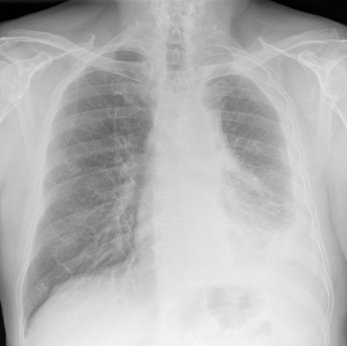
Are new treatments for mesothelioma being studied?
Are new treatments for mesothelioma being studied?
Yes. Because mesothelioma is very hard to control, the National Cancer Institute (NCI ) is sponsoring clinical trials (research studies with people) that are designed to find new treatments and better ways to use current treatments. Before any new treatment can be recommended for general use, doctors conduct clinical trials to find out whether the treatment is safe for patients and effective against the disease. Participation in clinical trials is an important treatment option for many patients with mesothelioma.
How common is mesothelioma?
Although reported incidence rates have increased in the past 20 years, mesothelioma is still a relatively rare cancer. About 2,000 new cases of mesothelioma are diagnosed in the United States each year. Mesothelioma occurs more often in men than in women and risk increases with age, but this disease can appear in either men or women at any age.
What is mesothelioma?
Mesothelioma (cancer of the mesothelium) is a disease in which cells of the mesothelium become abnormal and divide without control or order. They can invade and damage nearby tissues and organs. Cancer cells can also metastasize (spread) from their original site to other parts of the body. Most cases of mesothelioma begin in the pleura or peritoneum.
What are the symptoms of mesothelioma?
Symptoms of mesothelioma may not appear until 30 to 50 years after exposure to asbestos.
- Shortness of breath and pain in the chest due to an accumulation of fluid in the pleura are often symptoms of pleural mesothelioma.
- Symptoms of peritoneal mesothelioma include weight loss and abdominal pain and swelling due to a buildup of fluid in the abdomen.
- Other symptoms of peritoneal mesothelioma may include bowel obstruction, blood clotting abnormalities, anemia , and fever.
- If the cancer has spread beyond the mesothelium to other parts of the body, symptoms may include pain, trouble swallowing, or swelling of the neck or face.
These symptoms may be caused by mesothelioma or by other, less serious conditions. It is important to see a doctor about any of these symptoms. Only a doctor can make a diagnosis.