[작성자:] admin
New Drug for Mesothelioma
New Drug for Mesothelioma
Medical News Today recently reported the FDA has approved a new drug used to treat malignant pleural mesothelioma, a rare cancer usually associated with asbestos exposure. The drug is called Alimta, or pemetrexed disodium, and it’s distributed by Eli Lilly and Company. Alimta is intended to be used along with cisplatin.
It’s further reported in a randomized clinical trial, patients receiving Alimta along with cisplatin lived an average of 12 months after the trial began, compared with nine months for those on cisplatin alone.
Woman dies from washing husband’s asbestos laden clothes
Woman dies from washing husband’s asbestos laden clothes
The Sun Newspaper in the UK reports a woman died from inhaling deadly asbestos dust after years of washing her husband’s work clothes. An inquest as to the cause of death heard she shook out her carpenter Dennis’s overalls before washing — freeing particles of the deadly material asbestos. The local coroner recorded a verdict of death from an industrial disease.
She contracted the asbestos-related disease mesothelioma last June and died last month. Her husband is also ill and receiving medical treatment.
Air Force Veteran with Mesothelioma Campaigns For Republican
Air Force Veteran with Mesothelioma Campaigns For Republican
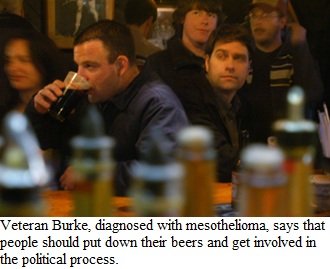 Diagnosed with mesothelioma a little more than 2 years ago, Patrick Burke at 55 had doctorstell him that he has a 10% chance to live 3 years. While he doesn’t know if he’ll survive to see the 2012 presidential election results, he won’t let the deadly disease stop him from campaigning for his candidate of choice, Rick Perry. According to the Fort Worth Star-Telegram, Burke devoted the past week in support of Perry in Iowa.
From Texas, Burke is a former Air Force veteran. To campaign for Perry was something on Burke’s “bucket list.”
When interviewed by the Telegram, Burke explained that he thought that all citizens had a duty to get involved in the political process, “I tell everybody to put down their beer and stop watching The Simpsons.’
Sadly, about 33% of mesothelioma patients are veterans who were exposed to asbestos while in service. Then, after they left the Air Force, they frequently took jobs that further exposed them to asbestos. This extended exposure inevitably led to countless diagnoses of mesothelioma.
One Response to Air Force Veteran with Mesothelioma Campaigns For Republican
-
-
Hello,
I have a question about your blog. Please email me!
Thanks,
David
-
Mesothelioma Victim Awarded $2.1 Million Verdict Against, Defeats Parts Manufacturer
Mesothelioma Victim Awarded $2.1 Million Verdict Against, Defeats Parts Manufacturer
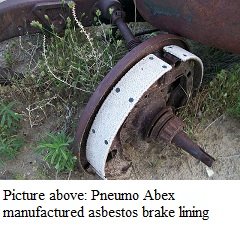 When James Lovelace was 10 years old, he loved to help his father, a big-rig truck driver, service his trucks. This included handling brake components that contained asbestos. Now 66 years old, Mr. Lovelace is a victim of the malignant cancer, mesothelioma.
The brake parts manufacturer, Pneumo Abex, said to the jury, that Lovelace was exposed to asbestos in a lot of other ways besides working with Abex brake parts. In other words, Defendant Abex’s claimed that it wasn’t the manufacturer’s fault that Lovelace suffered from mesothelioma. Rather, it pointed to the general exposure to the deadly material in his house. Through his childhood, Lovelace breathed and touched items that carried asbestos dust from his father’s workplace as a forklift operator at Johns Manville asbestos cement pipe plant in Stockton, CA.
After a three week trial, the jury did not buy much of Abex’s arguments. It turned around and awarded Mr. Lovelace $1 million for future noneconomic damages, $500,000 for past noneconomic damages; $430,000 for future economic damages; and $144,000 for past economic damages.
The SKWC asbestos injury attorneys congratulate Mr. Lovelace and his team of trial lawyers for this important victory.
One Response to Mesothelioma Victim Awarded $2.1 Million Verdict Against, Defeats Parts Manufacturer
-
-
Mary @ Legal Sentence says:
Congratulations. Asbestos injury is really an unusually enduring issue. Mr. Lovelace’s case is a mind-blowing experience in view of the fact that 56 life-long years have already elapsed. Great regard to his lawyers.
-

Illinois Judge Hands Over Asbestos Docket
Illinois Judge Hands Over Asbestos Docket
An Illinois circuit judge facing scrutiny from pro-business and pro-industry groups handed over his docket, asking that his county’s asbestos lawsuits be handled by another judge, according to a recent article in the Belleville News-Democrat.
Nicholas Byron ruled the Madison County Circuit Court that handles the country’s largest asbestos docket for about 10 years. In 2003 alone, he presided over 953 such cases. As a result, Madison County is notorious for its plaintiff-friendly reputation.
Such cases involving asbestos-related lung cancer often cumulate with multimillion-dollar awards, such as the $250 million judgment issued by a jury in Byron’s courtroom in 2003, the article says. And Byron himself awarded $10.1 billion to a class action suit against Philip Morris, the nation’s largest cigarette manufacturer.
Upon announcing his plans to hand over the docket, Byron — who is in his 70s — left for a vacation and was unavailable for comment. His associates declined to speak for him.
Although the recipients of the eye-popping awards surely appreciate Byron’s courtroom, tort-reform groups are less than pleased with his practices. In April, former U.S. Attorney Griffin Bell criticized the county responsible for 25 percent of the nation’s asbestos suits, says the Belleville article.
Gretchen Schaefer, a spokeswoman for the American Tort Reform Association, says: “Madison County is a magnet for asbestos litigation that has no connection to that jurisdiction. We hope to see fairness and balance in whoever takes over the asbestos docket by putting the citizens and taxpayers of Madison County first.”
Chief Judge Edward Ferguson says Byron will handle other types of lawsuits, with Circuit Judge Phillip Kardis taking over the swelling asbestos docket. Ferguson says handling the docket is “very, very time consuming because they’re all multiple-party cases with a lot of lawyers and litigants.”
Texas Judge denies request to postpone lawsuits
Texas Judge denies request to postpone lawsuits
A Texas judge has rejected requests by companies being sued for asbestos poisoning to create a separate docket dealing only with cases in which plaintiffs are sick. The companies wanted to delay all other cases until the victim developed asbestos-related sicknesses. Lawyers for the plaintiffs said the delays would deny their clients constitutional access to the courts and a trial by jury.
This was reported by the Star-Telgram quoting a portion of Judge Davidson’s findings: “At some point in the future, the number of cases filed which could qualify for assignment to an unimpaired docket could result in a denial of right to court access to other cases in which impairment is agreed to exist. It cannot be said that this is the case at this time for cases filed since Sept. 1, 2003.”
It was also reported more than 600,000 asbestos-related lawsuits have been filed nationwide, many by people who have not developed symptoms of asbestos-related illness. About a third of those were filed in Texas.
Fort Worth Custodian has no choice but to sue
Fort Worth Custodian has no choice but to sue
The Dallas Fort Worth Star-Telegram presented a heart moving story of another asbestos victim in Sunday’s May 2 paper. The paper further reports school maintenance workers may be at increased risk for developing diseases related to prolonged exposure to asbestos.
Reading the story, your heart has to go out to this custodian worker:
As Randall Blevins was recovering from surgery, doctors told his wife that the patches indicated exposure to significant amounts of asbestos. Presumably, they said, the right lung was the same.
That was May 2002, 25 years after Blevins began working as a heating and air-conditioning technician for the Fort Worth school district. He fixed boilers and repaired pipes — products often encased in asbestos.
Blevins, 50, believes that his lung disease stemmed from his work for the district because he knows of no other contact with asbestos dust.
From 1977, when he was hired, until about 1982, when the district stepped up its precautions, he handled asbestos without thinking. Blevins said he and the district’s other boiler-room workers hit it with their wrenches and ripped it off pipes with their bare hands while crawling under buildings. Each time, the white shards cascaded into their hair, eyes, noses and mouths.
“We would handle asbestos like it was nothing,” said Blevins, who lives in Southlake. “Might have on only paper masks.”
Blevins said he appears to be the only one in his maintenance team who has been diagnosed with asbestos-related symptoms. But asbestos illnesses typically don’t show up until decades later, and Blevins’ illness gives some of his co-workers pause.
“I look at him and think, ‘That could be me,’ ” said Arthur Cox, the district’s heating and air-conditioning foreman.
The Telegram Star goes on to report the plight of custodians and maintenance workers:
Longtime school custodians and maintenance workers are among the groups quietly paying the price for the nation’s slow reaction to the dangers of asbestos, a heat-resistant insulation used for decades before it was linked to high incidences of cancer.
Before the mid-1980s, maintenance workers commonly handled asbestos without protection, said Herman Earwood, former director of central services for the Fort Worth school district and now mayor of River Oaks.
“Everybody in the country was doing it because they didn’t know any better,” said Earwood, who supervised asbestos containment at the district.
Several medical studies have documented lung abnormalities in such employees, many of whom had no known exposure to asbestos outside their school duties.
Blevins had no other alternative than to file suit:
Blevins’ situation is dire. He has lost his school district insurance. He has been unable to find a doctor who will take workers compensation insurance and provide the long-term monitoring that he needs.
On April 21, Blevins filed a lawsuit in state district court against a long list of asbestos-product manufacturers in a last-ditch effort to find some way to pay his escalating medical bills.
Blevins’ body and spirit are broken. Once a 250-pound man who could perform one-arm pushups, he can no longer lift his 17-pound grandson….
Medical records indicate that Blevins showed evidence of asbestos-related damage in 2000, when a CT scan found thickened areas called pleural plaques on his left lung. The plaques aren’t cancerous, but they can be painful.
Blevins believes that they were the cause of his excruciating pain, which prompted doctors to prescribe numerous medications for pain and anxiety.
“He was hurting so bad at night that he was on his knees in the bed, crying,” said his wife, Cheryl.
By April 2002, another CT scan found more abnormalities: a 3-centimeter pleural mass, adjacent to the diaphragm; numerous pleural plaques, some of which had calcified; and possible mesothelioma.
“Findings are compatible with asbestos exposure,” the report said.
A month later, Blevins was in surgery. The doctors warned him that cancer was likely, but after months of waiting for the test results, he was told that the cells were benign. Good news.
But doctors say he must continue to be monitored.
“He’s truly at risk of malignant mesothelioma,” said David Carter, the cardiothoracic surgeon who performed Blevins’ surgery.
Blevins remains in extreme discomfort. He has had a heart attack. He shows signs of “post-thoracotomy syndrome,” a common lingering pain from lung surgery, Carter said. He has diabetes, and an inability to control the disease has contributed to a weight gain.
The incidence of asbesotos health problems for custodians is alarming:
A 1991 study of 120 Boston public school custodians found that 33 percent had pleural plaques. The study by Dr. Christine Oliver, an assistant professor at Harvard Medical School, was published in the American Journal of Industrial Medicine.
Lung abnormalities in Wisconsin school custodial and maintenance workers increased the longer they worked for their districts, according to a study published in a 1992 environmental journal. About 2 percent of those who had worked in schools less than 10 years had the abnormalities; 37 percent of those who worked more than 30 years in schools had them.
Blevins wife is not looking for money. “You know what I want? I want my husband back,” Cheryl Blevins said. “I just want us to grow old and enjoy our grandkids. I want him back the way he was before he got sick. But I don’t see that happening.”
Appeals Court Orders Judge to Step Aside in Three Asbestos Cases
Appeals Court Orders Judge to Step Aside in Three Asbestos Cases
The New York Times reports a federal appeals court ordered the judge overseeing five important asbestos-related bankruptcy proceedings to withdraw from three of the cases because of the appearance of bias. In a 2-to-1 decision, a panel of the United States Court of Appeals for the Third Circuit in Philadelphia ordered Alfred M. Wolin, a federal district judge in Newark, to end his role in the bankruptcy hearings involving W. R. Grace, Owens Corning and U.S. Gypsum because his handling of the cases had the appearance of bias.
The Times further reported:
Lawyers for the creditors objected to meetings that Judge Wolin conducted with plaintiffs’ lawyers and other parties to the case without a record being made for those who were absent. The meetings “were flawed because no opportunity existed for their adversaries to know precisely what was said” and what effects might result, the court said.
The creditors also argued that the judge had appointed advisers who were not impartial because they represented plaintiffs in a similar bankruptcy case in Newark involving a company called G.I. Holdings Inc. The court noted that the judge and his advisers met with asbestos plaintiffs’ lawyers for 325 hours over several years.
According to the Times, Legal experts said the decision would probably force new delays and might cause far-reaching economic repercussions in the long-running litigation, which involves thousands of people who say they were harmed by exposure to asbestos.
“He was deciding critical issues very much in the interests of plaintiff lawyers,” said Lester Brickman, a professor at the Benjamin N. Cardozo School of Law at Yeshiva University, who has studied asbestos litigation. The dispute involving Judge Wolin has already led plaintiffs’ lawyers to increase their settlement demands significantly in many other cases involving companies that are not in bankruptcy proceedings to make up for the delay in resolving the five cases, Mr. Brickman said.
Mississippi high court rejects asbestos company claims against tobacco makers
Mississippi high court rejects asbestos company claims against tobacco makers
The Associated Press reports the Mississippi Supreme Court ruled that Owens Corning has no claim against tobacco companies over asbestos-related lung injuries. Owens Corning was trying to recover billions of dollars paid out in asbestos settlement cases by arguing the tobacco industry shared some of the blame for the health problems.
Asbestos companies have blamed cigarette smoking for thousands of workers’ injuries costing them millions of dollars in damages. Companies that previously manufactured products containing asbestos, including Toledo, Ohio-based Owens Corning, have gone into bankruptcy paying injury claims.
The report covered the competing arguments:
Lawyers for the tobacco companies said Owens Corning could not prove cigarette makers were liable for anything.
Owens Corning argued if the tobacco companies had been truthful about the harmful effects of tobacco, it and others might not have had to pay out huge settlements. The company said it was in bankruptcy as the result of lung disease litigation while the tobacco companies have continued to prosper.
The tobacco companies said whatever the alleged acts Owens claims the tobacco industry did had nothing to do with Owens’ decision to make settlement payments to victims. Industry lawyers said if Owens had not sold asbestos they would not have paid anybody anything.
The impact of Asbestos claims on Owens Corning has been pretty substantial but so have the numbers of people made ill by their asbestos:
At the time of its bankruptcy filing in 2000, Owens Corning estimated it had paid or agreed to pay $5 billion in asbestos lawsuit claims. The supplier of building and industrial material said it faced about $2 billion more in asbestos payouts even though it stopped selling insulation that contained asbestos more than 25 years ago.
The company has paid money to 440,000 people who said asbestos made them ill.
SCOTUS Pulls Plug on Plaintiffs’ Right to Asbestos Injury Claims Against Railroads
SCOTUS Pulls Plug on Plaintiffs’ Right to Asbestos Injury Claims Against Railroads
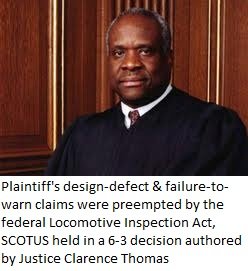 The U.S. Supreme Court has rejected a legal theory that would have given asbestos injury attorneys a new industry to attack with lawsuits.
SCOTUS ruled this past Wednesday in favor of companies involved with the design and manufacture of locomotives and their parts. The estate of the late George Corson, a welder and machinist for a railroad carrier, had sued Railroad Friction Products Corp. and Viad Corp. in Philadelphia, alleging injury from exposure to asbestos in trains and train parts distributed by the companies.
The estate’s design-defect and failure-to-warn claims were preempted by the federal Locomotive Inspection Act, the court held in a 6-3 decision authored by Justice Clarence Thomas. The decision was in line with one made by the court 85 years ago in Napier v. Atlantic Coast Line.
“(P)etitioners contend that the LIA’s preemptive scope does not extend to state common-law claims, as opposed to state legislation or regulation,” Thomas wrote.
“Napier, however, held that the LIA ‘occup(ied) the entire field of regulating locomotive equipment’ to the exclusion of state regulation. That categorical conclusion admits of no exception for state common-law duties and standards of care.”
The decision affirmed a ruling by the U.S. Court of Appeals for the Third Circuit. It had been removed from a state court to Philadelphia federal court.
Dissenting were justices Sonia Sotomayor, Ruth Bader Ginsburg and Stephen Breyer. Sotomayor’s dissenting opinion said that the plaintiffs’ claim for failure to warn was not preempted, though it agreed the defective design claim was.
The federal government and the American Association for Justice were among the groups supporting the plaintiffs’ lawsuit.
“Because the right to a legal remedy for wrongful injury is a fundamental right under the Constitution, courts may not preempt such a cause of action and leave injured persons without remedy unless Congress specifically intended that result,” the AAJ’s amicus brief said.
“The mere silence of Congress in a statute not directed at railroads rather than manufacturers falls short.”
Complaints against 50 other companies were dismissed.
4 Responses to SCOTUS Pulls Plug on Plaintiffs’ Right to Asbestos Injury Claims Against Railroads
-
-
Gallbladder Cancer Symptoms says:
Fastidious answer back in return of this difficulty with real arguments and telling everything on the topic of that.
-

-
-
phones says:
This is a topic which is near to my heart.
.. Best wishes! Exactly where are your contact details though?
-

-
-
soumission assurance automobile quebec says:
Great beat ! I would like to apprentice while you amend
your web site, how can i subscribe for a weblog site?
The account helped me a acceptable deal. I have
been tiny bit acquainted of this your broadcast provided brilliant clear conceptwebmaster ofhttp://www.assurancedossiercriminel.net and
http://www.soumissionassurance.ne
-

-
-
Posted by My Industrial Injury Claims.com says:
Useful information. Fortunate me I discovered your website accidentally, and I am stunned why this accident didn’t happened in advance! I bookmarked it.
-


David Haas says: